
By Andrew Kidd
(Editor’s note: This is the second in a three-part series about the new lighting in the sanctuary. In the first installment, Andrew Kidd explained the reasons for this upgrade and its potential impact on the church.)
I spent the latter part of my career designing and implementing audiovisual systems for museums. This gave me access to people who could help. Although I didn’t design or install lighting systems, I worked with lighting designers. One of them, Ted Mather, lives in New Jersey. I called him for advice, and he volunteered to come to Titusville to take a look.
An hour and a lunch later, I learned that a full theater-stage system would cost a lot, require much more power than we had available, and need a skilled technician to operate it. That ended that idea, but Ted told me about an LED bulb made by Soraa that he used in museum exhibits. It offers a range of brightness levels, color temperatures, and beam angles. The latter was especially important because it would allow us to control where the light landed. He also told me that the “magic” angle for theater lighting is 45 degrees down.
Armed with this information, I bought three bulbs with different beam angles—9, 25, and 36 degrees—and tested them in my basement. They seemed well suited to our purpose.
The bulbs also had to be easy to reach and replace. The existing pendant bulbs in the sanctuary are 16 feet off the floor, which seemed like a good height, as long as we purchased a suitable A-frame ladder. We did, and Roberto Santiago used it and approved it.
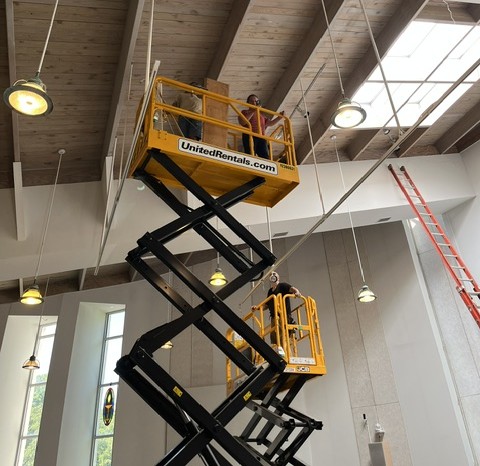
Next, I needed a way to hang the bulbs so they would illuminate the stage while remaining as aesthetically “invisible” as possible. The bulbs would be mounted on a lighting track, supported by a steel bar called Unistrut and suspended from the ceiling by threaded rod.
Then came power. Four lighting tracks installed over the stage when the sanctuary was built in 1996 were each fed by a separate switched/dimmed electrical circuit. Although the tracks themselves would become redundant, reusing their power feeds would save considerable time and money.
So, I had the product, the installation method, and power. Now I had to put everything together to illuminate the stage at the ideal 45-degree downward angle.
After studying the architect’s drawings, taking measurements, and thinking it through, I determined that two tracks were needed—one to light the back of the stage and another for the front. The four existing power branches would provide lighting for the center of the stage, the front wings for the choir, the rear wings for a large band, and the curved wall.
That completed the design portion of the project. Next month, I’ll discuss implementation.