
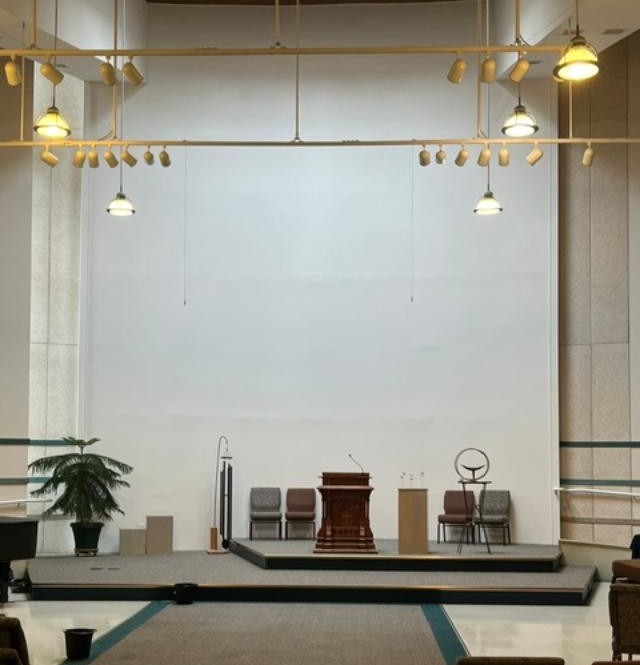
After years of dimly lit presenters and performers, a lighting upgrade is finally taking center stage.
By Andrew Kidd
(Editor’s note: Starting with the August 30th service, you may have noticed a change in the sanctuary lighting, which now better illuminates the podium. In the first installment of a multi-part series, Andrew Kidd explains the reasons for this upgrade and its potential impact on the church.)
I have been a member of UUCWC for 26 years and have attended many daytime Sunday services and evening events in the Sanctuary. Over that time, there have been occasions when my concentration on the subject matter or the presenter has not been 100%. During these periods, I have often gazed around the sanctuary and wondered why the architect designed certain elements the way he or she did, particularly the lighting over the stage.
For reasons now probably lost to history, three lighting tracks were placed at ceiling level, 28 to 30 feet above the floor. Two were placed on either side of the skylights, and the third, directly over the front lip of the stage.
There are several problems with this design:
- The conventional 120-watt tungsten bulbs were mounted so high above the floor that only the very brave dared to climb a ladder to replace them when they burned out. The last person to do so was Jon Holcombe, who served as sexton for a few months many years ago. As a firefighter, he was used to scaling tall ladders. By 2026, only four of the eight bulbs were working, and three of those were on their last legs.
- The light output from these bulbs had negligible effect once it had traveled 28 feet to the stage floor.
- They were directly overhead of presenters or artists on stage, so they illuminated only the tops of their heads and the bridges of their noses. Faces were in shadow, making them difficult to see.
- During the day, the lighting had to compete directly with the sunlight pouring through the skylights.
- The existing bulbs are of the old tungsten variety, where eight of them consume over 900 watts of power (when they all work). Modern LED bulbs, even though more would be required, would use about twenty-five percent of that, resulting in significant energy savings.
Any one of these problems was enough to doom this arrangement, but it was especially obvious at evening events, when, after dusk, the performers would become almost invisible.
We had gotten away with this defect for years because services occur mostly during daylight, though Reverend Kim did point out that Vespers and the Christmas Pageant were always gloomy in terms of lighting. For evening events, we have either rented lighting or just done without.
We have a beautiful, highly functional space within that sanctuary. The acoustics are good, and we have a decent, aesthetically pleasing sound system. We should be renting it out regularly, as the Board has indicated this is now a priority revenue source. In the meantime, several booking agents have found us and plan to use the space for their concerts.
So, after years of pondering, I decided that something had to be done.
(Editor’s note: Read about the design and the installation in the October and November issues of CrossCurrents.)