
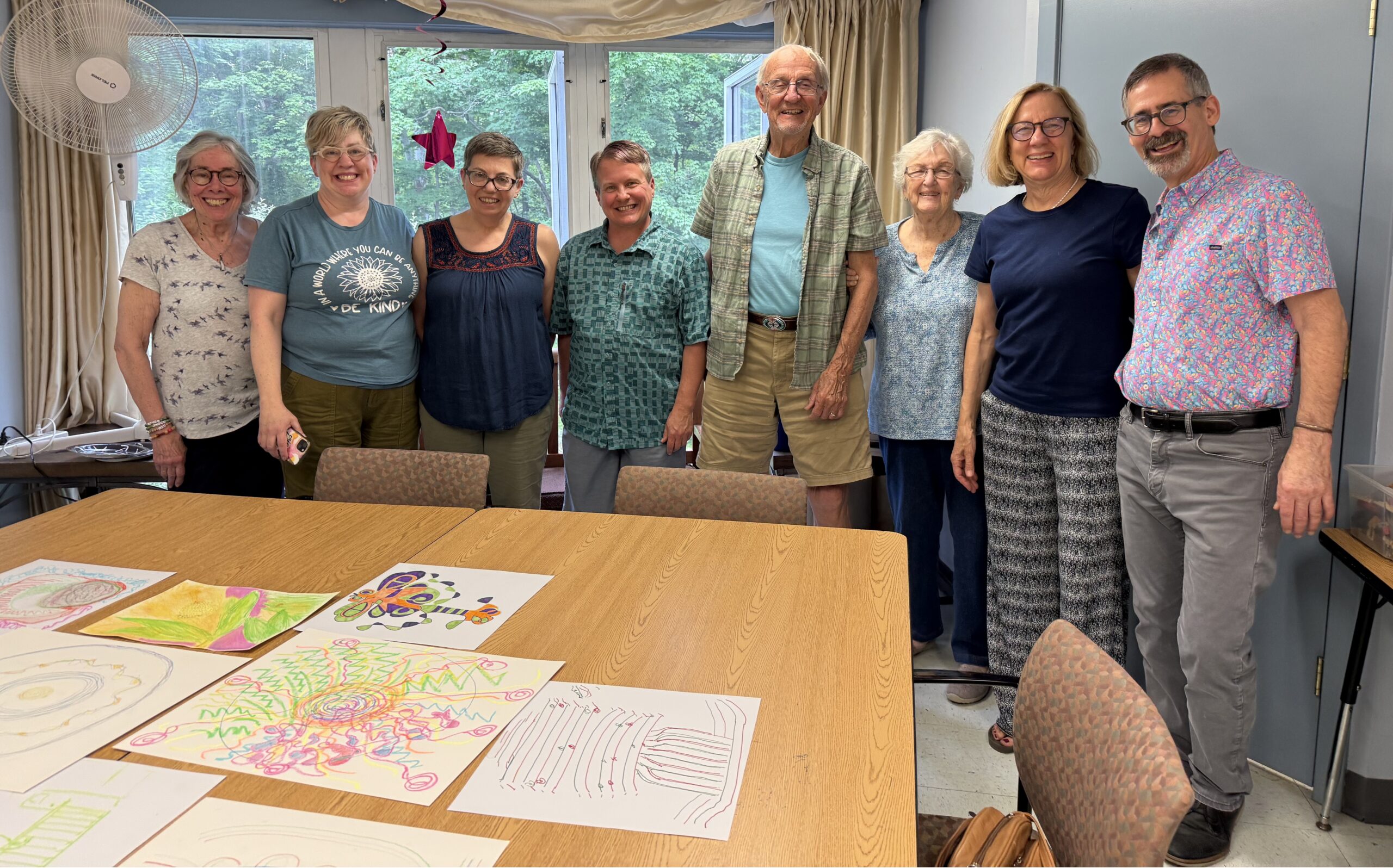
The intuitive drawing class students and their work.
Intuitive drawing can open the door to creativity, reflection, and joy.
By Joseph Goldfedder
After leading an intuitive drawing class in June as part of the Sharing Our Joy auction, I found myself reflecting on the experience.
People often say “I can’t draw” because they equate it with creating a realistic likeness. But drawing is so much more. It’s a language that expresses ideas, emotions, and experiences beyond words. Like handwriting, every person’s marks are unique.

Joseph Goldfedder, the class facilitator.
As an acupuncturist, I’m fascinated by the relationship between the hand and the heart. Several meridians pass through both hands, making drawing feel not only like a creative act but also a bridge between inner experience and physical expression.
Our intuitive drawing class began with a brief meditation accompanied by the sound of Tibetan singing bowls. Guided by a series of prompts, the class started drawing.
Drawing quiets the mind and invites a more sensory way of experiencing. Through mark-making, unexpected memories, emotions, and images often surface. The room grew quiet as the class became absorbed in the simple pleasure of making marks on paper. Creativity blossomed.

Examples of the intuitive drawing class’s creativity.
If you’d like a few prompts to capture your imagination, here’s a simple practice you can try at home.
Start by gathering your materials, including paper, crayons, colored pencils, markers, pastels, or pens.
- Close your eyes
- Feel your body supported by the chair and your feet firmly resting on the floor.
- Follow your breath for several slow, easy cycles, allowing your body to relax.
- Imagine light radiating from your heart, gently filling your entire body.
- When you feel ready, open your eyes.
- Using your non-dominant hand, begin making simple marks or scribbles on the paper. Let your hand move freely without trying to create anything recognizable.
- Gaze at the page and notice if an image, shape, memory, or feeling begins to emerge from the marks.
- Once something catches your attention, switch to your dominant hand. Begin responding to what you see. Add lines, color, texture, or new forms, allowing the drawing to unfold naturally rather than trying to control the outcome.
- Continue until the drawing feels complete. Take a few quiet moments to observe what has emerged and reflect on anything the process revealed.
- Use this practice anytime you want to tap into your creativity.
The next time you find yourself saying, “I can’t draw,” instead, consider what you might discover through drawing. It’s not about making perfect pictures; rather, it’s about giving yourself permission to listen within. By strengthening your intuition, you deepen your capacity to “create community, celebrate life, and change the world.”